
The evidence / The context
What makes some saunas more energy-efficient than others?
When I assess sauna efficiency, I start with the electricity needed for a complete session, including warm-up. What makes some saunas more energy-efficient than others? Mostly a smaller, well-insulated enclosure, less heat escaping, an…
Educational information, not medical advice. This analysis explains evidence and context; it does not provide an individualized heat-exposure plan.
Evidence status: Evidence reviewed. Duration, temperature, health history, medications, and individual response can change what is appropriate.
The bottom line / Evidence
The bottom line
Read the full article for the evidence, assumptions, and limits behind the answer. A lower or higher number is not meaningful without the heater type, heat load, and the person using it.
When I assess sauna efficiency, I start with the electricity needed for a complete session, including warm-up. What makes some saunas more energy-efficient than others? Mostly a smaller, well-insulated enclosure, less heat escaping, an appropriately sized heater, and sensible temperature and timer settings. Infrared and portable designs can use less electricity because they often heat a smaller space or operate at lower air temperatures. That does not establish superior health benefits.
The evidence needs separating here. The 2018 Mayo Clinic Proceedings review discusses cardiovascular and other potential benefits of sauna bathing; it does not rank appliances by electricity consumption. My clinical judgment is straightforward: buy for a tolerable, repeatable experience, then compare the energy needed to deliver it. A wattage label cannot tell you either the full operating cost or the medical value.
1. Efficiency means more than a low wattage label
Kilowatts (kW) measure power; kilowatt-hours (kWh) measure energy used over time. A 1,500-watt appliance draws 1.5 kW at its rated load. If it runs continuously at that load for one hour, it uses 1.5 kWh. Your electricity bill charges for energy, so heater runtime matters as much as rated power.
Electric resistance heaters convert essentially all their incoming electricity into heat at the point of use, as the Australian government’s heating guidance explains. Both conventional electric sauna elements and electrically powered infrared emitters ultimately produce heat. The practical difference is where that heat goes, how much material must warm up, and how rapidly heat escapes.
A powerful heater that finishes warming a suitable cabin quickly may use less energy than a weaker heater running much longer. Conversely, a large heater does not automatically save electricity. Compare measured kWh from a cold start through the end of use, at stated room and outdoor temperatures. Include any powered drying cycle. Compare similar occupancy and a similar experience; matching the thermometer alone does not make different heat technologies equivalent.
2. Traditional, infrared, and portable saunas have different heating jobs
A traditional electric sauna heats stones, room surfaces, and air. Infrared panels transfer radiant heat to exposed surfaces, including skin, while also warming the enclosure. The 2024 review of passive heat therapies describes Finnish sauna research largely involving high air temperatures, around 80 to 100 degrees Celsius. Infrared use generally involves lower air temperatures, but its warmth also depends on panel placement and distance from your body.
Portable steam tents have another job: heating water and producing steam. High humidity limits evaporative cooling, so a lower air temperature can still feel intense. Sauna blankets heat close to the body and enclose little air. Neither sweating intensity nor a low electricity bill proves these products reproduce the outcomes studied in Finnish saunas.
| Design | What can reduce session energy | Tradeoff to examine |
|---|---|---|
| Traditional electric cabin | Insulated walls and ceiling, suitable heater, limited idle time | Air, stones, and cabin materials need warming; shared sessions can improve energy per user |
| Infrared cabin | Lower air temperature and a compact enclosure | Panel coverage and actual warm-up time matter; large cabins still need substantial energy |
| Portable steam tent | Small occupied volume and short operating periods | Steam generation, leakage, and subsequent room moisture management add demand |
| Sauna blanket | Heating close to the body with little surrounding space | Restricted movement, cleaning requirements, and a different exposure from cabin sauna |
My clinical take: lower operating cost is a practical advantage, not evidence of a better treatment. The 2021 review, Sauna use as a lifestyle practice to extend healthspan, discusses promising biological mechanisms and health associations. It does not establish which consumer sauna delivers the most benefit per kWh. Long-term observational associations also cannot prove that sauna use itself caused better outcomes.
3. Size, insulation, and glass determine how much heat you need
Buy space you will actually use
A larger sauna generally needs more energy because there is more enclosure material to warm and more surface area through which heat can escape. Extra ceiling height adds volume without necessarily adding useful seating. But reducing dimensions indiscriminately can undermine comfort, bench positioning, and required heater clearances. Start with actual users and a manufacturer-approved layout.
A family sharing one heating cycle may use less energy per person than several people each warming a smaller sauna from cold. For a mostly solo routine, however, routinely heating empty benches is an avoidable expense. Compare both kWh per session and kWh per user when choosing capacity.
Look behind the wood finish
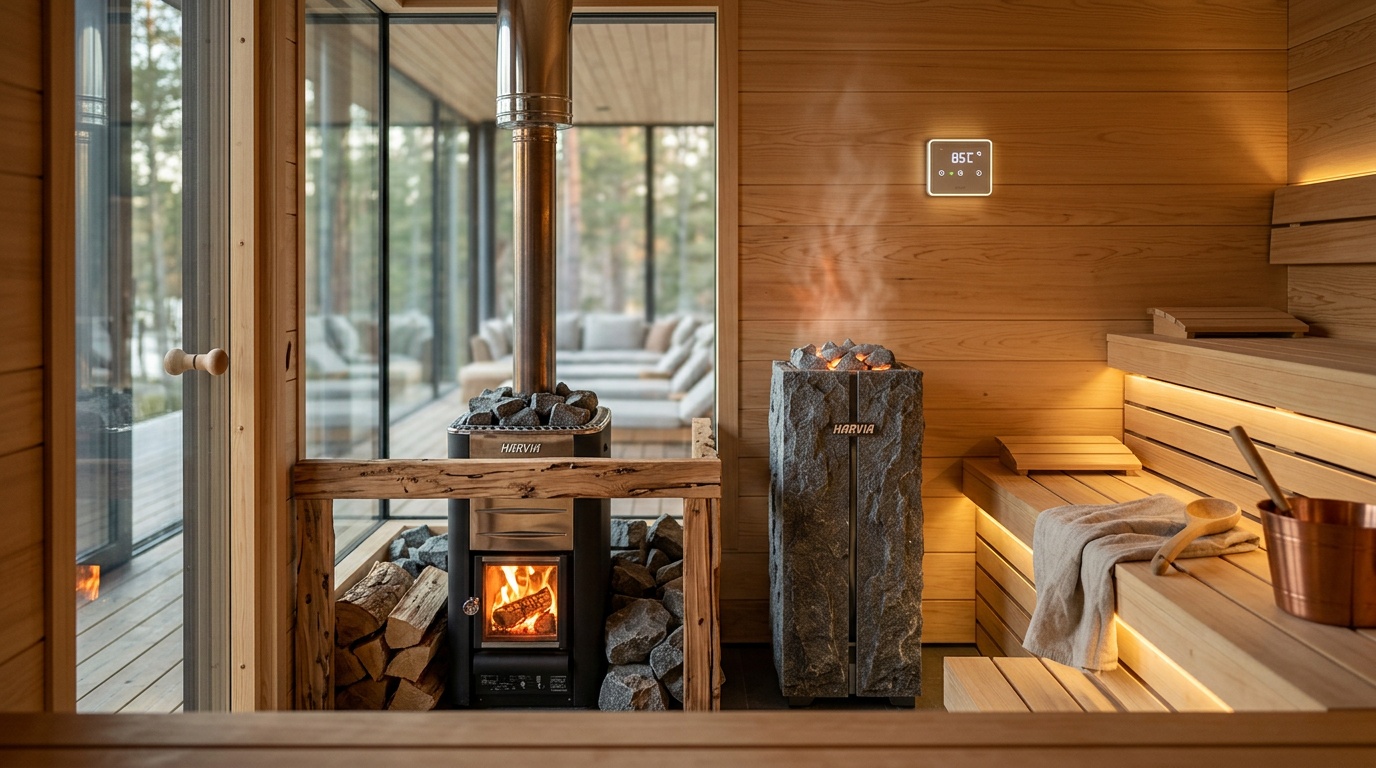
Ask for the wall and ceiling construction, insulation specification, door details, and outdoor rating. Attractive timber does not tell you how well the assembly retains heat. Glass and exposed masonry can materially change heater requirements. Harvia’s sizing guidance treats each square meter of glass, stone, or similar uninsulated surface as an additional 1.2 cubic meters of calculated sauna volume.
That is a sizing rule, not a prediction of percentage savings. It explains why two cabins with the same dimensions may need different heaters. A panoramic glass front can be worth buying for the view, but its thermal consequences belong in the decision. For an existing sauna, have damaged seals or insulation assessed using materials and methods suitable for sauna temperatures.
4. Location, ventilation, and age change the result
Outdoor placement increases the importance of construction
A sauna starting in a Minneapolis winter has more warming to do than one inside a conditioned room. A bigger indoor-to-outdoor temperature difference increases heat loss through the enclosure; wind can worsen leakage around imperfect joints. Outdoor installations therefore deserve particular attention to weather protection, insulation, and the manufacturer’s permitted operating conditions.
An indoor sauna also interacts with the house. Escaping heat may offset some space heating in winter and increase cooling demand in summer. A steam tent can require ventilation or dehumidification afterward. The appliance’s meter reading measures its own electricity; it does not capture every change to household heating, cooling, or moisture control.
Ventilation is a requirement, not wasted heat to eliminate
Follow the manufacturer’s ventilation design. Excess airflow can carry heat away unnecessarily, but blocking required vents to save electricity is a poor tradeoff. Ventilation supports the intended bathing environment and drying. Harvia identifies ventilation, materials, temperature, session length, and heater sizing as interacting variables in its sauna energy-use guidance.
Age matters through condition
An older resistance heater does not inherently become much worse at turning electricity into heat. Rising session consumption warrants checking changed habits, door fit, enclosure damage, sensor operation, and heater performance. Deteriorating components may change warm-up behavior without increasing rated power. Inspect stones and service components according to the manual. Replacement is justified by condition, safety, or measured performance, not the calendar alone.
5. Calculate the full cost, including warm-up
Energy in kWh = power in watts / 1,000 x hours operating at that power. Then multiply kWh by your electricity rate. For a cycling heater, calculate each phase separately or measure actual consumption. The fraction of time a heater runs is its duty cycle; do not assume a universal percentage.
Use the sauna energy cost calculator to separate warm-up, session duty, accessories, and standby in one planning estimate. Enter your own rate and equipment figures; the result is arithmetic, not heater-sizing approval or a promise of actual utility cost.
Consider these hypothetical examples, all using an illustrative rate of $0.20/kWh. These are arithmetic examples, not measured product averages:
- Portable 1,000-watt unit: 15 minutes of warm-up plus 30 minutes of use at continuous full power equals 1 x 0.75 = 0.75 kWh, or $0.15.
- Infrared 1,500-watt cabin: 20 minutes of warm-up plus 30 minutes of use at continuous full power equals 1.5 x 50/60 = 1.25 kWh, or $0.25.
- Traditional 6,000-watt cabin: 30 minutes of full-power warm-up uses 3 kWh. Another 30 minutes with the heater on half the time adds 1.5 kWh: 4.5 kWh, or $0.90.
At 20 sessions per month, those assumptions produce $3, $5, and $18 respectively. Actual results change with preheating, thermostat cycling, temperature, weather, and additional loads. A “30-minute session” cost that excludes 45 minutes of warm-up is incomplete. For a continuous full-power estimate, use the appliance’s total rated input, including any separate generator or heaters.
Use your bill’s applicable per-kWh charges, including variable delivery charges where relevant. Fixed monthly fees generally do not increase because you use a sauna. Time-of-use pricing can make an identical session cheaper at another hour without reducing its energy consumption.
For a compatible plug-in model, a plug-in electricity usage monitor with kWh recording can help verify consumption. Match its voltage, current, continuous-load rating, and environmental limits to the appliance; keep it outside the hot or wet enclosure and follow both manuals. Hardwired or higher-power systems need appropriately installed circuit monitoring, not a household plug adapter.
As an Amazon Associate, HeatDepth earns from qualifying purchases. Record several complete cycles alongside starting temperature, settings, and runtime. That gives you a useful baseline for evaluating changes.
6. Spend on measurable improvements
My buying priority is a comfortable size, documented enclosure construction, correct heater sizing, and dependable controls. Features such as automatic shutoff can reduce accidentally prolonged operation. A connected app only saves electricity if it changes behavior; starting preheat too early can do the opposite.
- Request complete-session measurements. Ask what starting temperature, setpoint, occupancy, and duration produced the quoted kWh.
- Match the heater to the installation. Use the manufacturer’s adjusted volume calculation rather than choosing the lowest wattage available.
- Reduce unnecessary running. Learn the actual warm-up time and avoid leaving the sauna ready long before use.
- Maintain the enclosure and equipment. Address deterioration before buying a replacement advertised as efficient.
- Check payback. Compare annual electricity savings with the extra purchase and installation cost.
If an upgrade saves 1 kWh per session at $0.20/kWh over 200 annual sessions, it saves $40 a year. A $1,000 premium would take 25 years to recover through electricity alone, ignoring maintenance and price changes. Comfort or durability might still justify it, but the energy claim needs that context.
Clinically, I would not extend heat exposure to get my money’s worth from preheating. Lower running costs should support a manageable routine. Harvard Health’s sauna safety guidance advises avoiding alcohol, limiting sessions, and checking with a physician when heart disease or uncontrolled blood pressure is present. Leave if you feel unwell; dizziness is a reason to stop, not a target.
For a fair home comparison, change one thing at a time. Keep the bathing period and target setting consistent while testing a shorter preheat, then compare several sessions under similar starting conditions. A single unusually warm afternoon can make a change look more effective than it is. Record comfort as well as electricity: saving a small amount while the seating area never warms adequately is not a successful purchase. For portable equipment, also check how much time cleaning and drying require, since a convenient routine is easier to maintain.
Frequently asked questions
What is the difference in energy usage between traditional and infrared saunas?
A compact infrared cabin can use less electricity because it generally operates at lower air temperatures and has less thermal mass to warm. The actual gap depends on size and complete runtime. There is no universal savings percentage that applies to every pair of models.
How does sauna size impact energy consumption?
Larger cabins generally require more energy per heating cycle. Insulation, glass area, ceiling height, and occupancy affect the comparison. A shared larger sauna may have a lower energy cost per person.
Does the location of the sauna impact its energy consumption?
Yes. Cold outdoor conditions increase warm-up demand and heat loss. Indoor placement changes the balance but can add household cooling or moisture-management costs.
How does the age of a sauna affect its energy consumption?
Condition matters more than age alone. Poor door fit, damaged insulation, or faulty controls can change consumption. Measure performance and investigate deterioration before replacing working equipment.
What factors affect sauna electricity consumption?
Heater power, operating time, cycling, temperature, size, insulation, ventilation, ambient conditions, and accessory loads all contribute. Warm-up and idle time are particularly easy to overlook.
How can I calculate my sauna’s energy costs?
Multiply measured session kWh by your applicable electricity rate, then by monthly sessions. Without a meter, watts divided by 1,000, multiplied by operating hours, gives a full-power estimate. Include preheating and any powered drying.
Safety is part of the protocol
Stop signals deserve attention.
Leave the heat if you feel unwell, dizzy, faint, nauseated, or develop a headache. Do not push through symptoms to complete a session. People who are pregnant, have cardiovascular or other relevant conditions, or take medications that affect heat response should ask a qualified clinician before sauna use.