
The evidence / The context
How do I track how much power my sauna is using?
I would track a sauna’s electricity use with a meter that records kilowatt-hours (kWh), starting before preheating and finishing after the normal shutdown cycle. For a compatible plug-in portable sauna, that can be a…
Educational information, not medical advice. This analysis explains evidence and context; it does not provide an individualized heat-exposure plan.
Evidence status: Equipment meets context. Duration, temperature, health history, medications, and individual response can change what is appropriate.
The bottom line / Evidence
The bottom line
Read the full article for the evidence, assumptions, and limits behind the answer. A lower or higher number is not meaningful without the heater type, heat load, and the person using it.
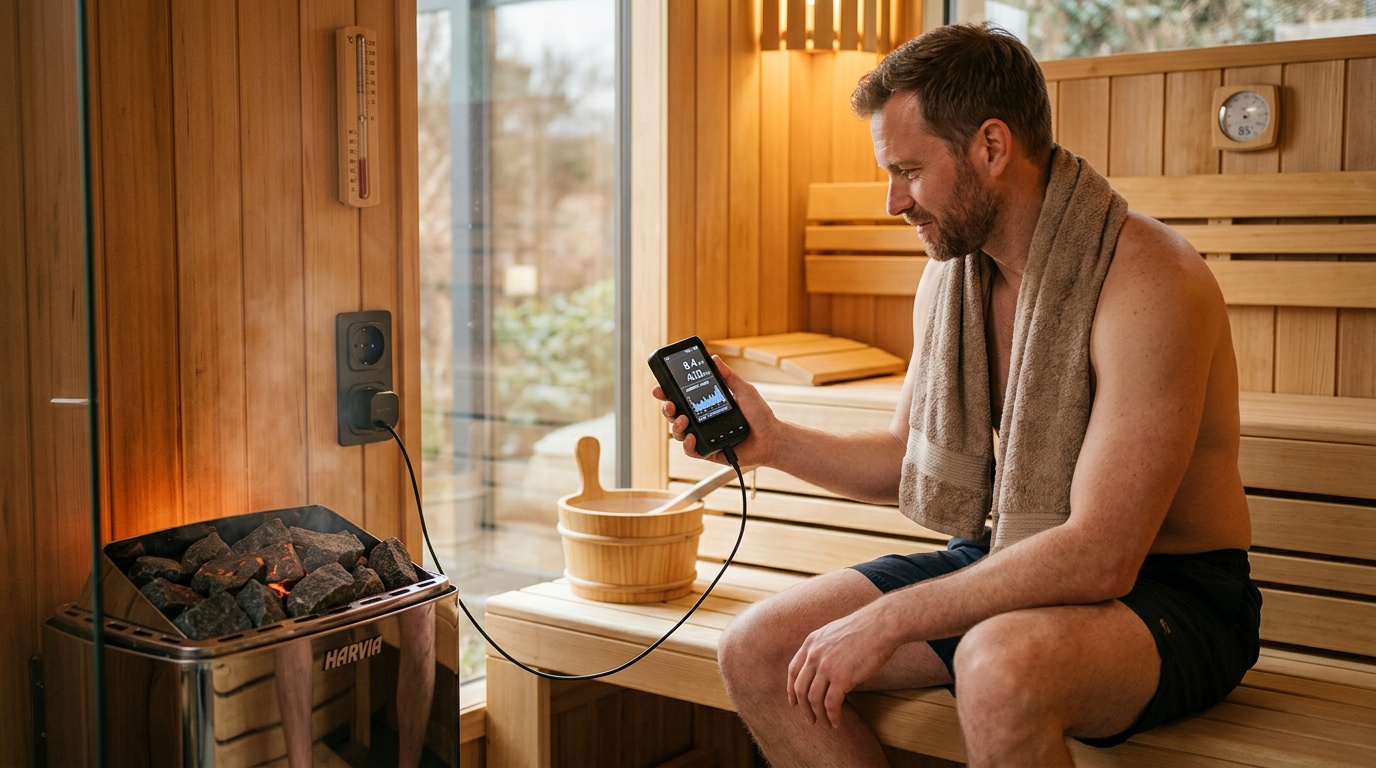
I would track a sauna’s electricity use with a meter that records kilowatt-hours (kWh), starting before preheating and finishing after the normal shutdown cycle. For a compatible plug-in portable sauna, that can be a properly rated plug-in energy monitor. For a hardwired or 240-volt sauna, use an electrician-installed circuit monitor or submeter. Multiply the measured kWh by your electricity rate to find the session cost.
As an integrative medicine physician, I am skeptical when electrical specifications get presented as evidence of better treatment. A meter can tell you what your sauna costs to operate. It cannot tell you whether you received an effective medical “dose.” My practical answer to “How do I track how much power my sauna is using?” is to measure three representative sessions, include warm-up, and keep the energy data separate from claims about health benefits.
This article contains affiliate links. HeatDepth may earn a commission from qualifying purchases.
1. Understand the number you actually need
Watts measure power at a particular moment; kilowatt-hours measure energy used over time. A heater drawing 1,000 watts continuously for one hour uses 1 kWh. The same heater running continuously for half an hour uses 0.5 kWh. Your utility generally charges for the accumulated energy, not the biggest wattage number you see on a display.
The wattage on a sauna’s label describes its rated electrical input, rather than a measured session total. Many heaters cycle on and off or reduce their output as the temperature approaches the set point. A reading taken while the element is off can therefore look reassuringly low while missing most of the electricity used during warm-up.
Look for a monitor that displays cumulative kWh as well as watts. For app-based systems, confirm that it stores energy history and lets you identify the session’s start and finish. Temperature displays, timers, and estimated “eco scores” are not substitutes for electrical measurement.
A useful estimate before buying anything
Energy in kWh = watts ? 1,000 ? operating hours. As a hypothetical example, a 1,200-watt portable sauna operating at full rated power for 45 minutes would use 0.9 kWh. That is a full-power estimate, not a promise about what a particular model consumes. Thermostat cycling may reduce it; excluding preheating would undercount the total.
Before buying a meter, use the sauna energy cost calculator to model warm-up, session duty, accessories, standby, and your electricity rate. It is an arithmetic planning estimate—not measured consumption or an electrical installation, code, heater-sizing, or utility-cost guarantee.
2. Match the measuring method to your sauna
Read the sauna’s nameplate and manual before choosing a meter. Check voltage, current, wattage, plug type, and any requirement to connect directly to a wall outlet. The following options answer different questions; paying for more features does not necessarily improve a simple session-cost calculation.
| Method | Best fit | Main limitation |
|---|---|---|
| Plug-in kWh meter | A portable sauna whose electrical requirements and manual permit it | Must support the actual load and operating conditions |
| Energy-monitoring smart plug | A compatible plug-in unit when energy history is useful | Some plugs lack kWh logging or restrict heater use |
| Circuit energy monitor or submeter | Hardwired, high-power, or 240-volt installations | Requires correct installation and circuit configuration |
| Utility meter or interval data | A rough check without buying equipment | Includes other household loads and may average over long intervals |
| Nameplate calculation | A preliminary budget estimate | Does not measure thermostat cycling or actual runtime |
For portable saunas: a basic meter may be enough
A plug-in electricity usage monitor with a kWh display is the category I would consider first for a compatible portable unit. Choose the version intended for your country’s electrical supply, with documented load ratings and recognized safety certification. Check restrictions on sustained heater loads rather than relying on a large wattage claim in the listing.
Do not add a meter if the sauna manufacturer prohibits intermediate devices. Keep the monitor outside the heated enclosure, away from steam, splashes, and condensation. Avoid extension cords, power strips, and adapters used to force an incompatible connection. A loose connection, unusual plug heating, discoloration, or burning smell is a reason to stop use and have the setup checked.
A smart plug deserves extra scrutiny because it contains a switching mechanism as well as any metering electronics. Verify that its manufacturer permits the particular heater load. Energy logging does not justify adding remote-start automation that the sauna was not designed to support.
For hardwired saunas: measure the circuit
For a larger installation, ask an electrician about a dedicated kWh submeter or a panel monitor with sensors on the sauna circuit. A household plug-in meter is not an appropriate workaround for a 240-volt heater.
Correct configuration matters as much as the device. A monitor needs to account for the entire load, including both supply legs where applicable and separately powered controls or accessories if you want a complete system total. Emporia’s sensor documentation distinguishes balanced 240-volt loads from circuits with unequal loads on the two legs. Have the installer follow the specific monitor’s instructions instead of assuming that one sensor reading should always be doubled.
My buying judgment: compatibility and trustworthy kWh readings matter more than an elaborate dashboard. A panel monitor may be worthwhile for broader household energy management; it can be excessive if your only goal is to price an occasional portable-sauna session.
3. Measure three complete sessions
One session provides a starting point. Three sessions under similar conditions give you a more useful baseline without turning a simple household question into a research project. Use your normal routine rather than extending the session to make the test easier.
- Record the setup. Note the sauna model, temperature setting, approximate room or outdoor temperature, and whether it is starting cold.
- Record starting kWh. Reset the meter if its instructions allow, or write down its cumulative reading before switching on.
- Include preheating. Note when warm-up begins and when you enter. A separate reading at entry can show how much energy warm-up consumes.
- Finish normally. Include any manufacturer-required powered drying or cooldown cycle. Record final kWh before unplugging a meter that may lose its stored reading.
- Subtract and repeat. Final kWh minus starting kWh equals session energy. Average three sessions, keeping the individual results so you can see the spread.
For example, suppose your measurements are 0.72, 0.81, and 0.78 kWh. The average is 0.77 kWh per session. A log entry can be as simple as ?15-minute warm-up, 20-minute session, usual temperature setting, 0.77 kWh.? Record standby consumption separately if the controller remains powered between sessions.
In a Minneapolis winter, an outdoor sauna starting cold is a different test from the same sauna in summer. Compare similar starting conditions before deciding that a heater has become inefficient. Water volume in a portable steam generator, door openings, and consecutive users can also change the result.
4. Convert the reading into a realistic bill estimate
Session cost = measured kWh ? applicable price per kWh. At an illustrative electricity rate of $0.20 per kWh, a 0.77-kWh session costs about $0.15. Sixteen such sessions use 12.32 kWh and cost about $2.46. These are worked examples, not typical-use claims or a local rate quote.
Use the variable charges on your electricity bill, including applicable per-kWh supply and delivery charges. Fixed monthly customer fees generally do not increase because you use a sauna, so allocating the entire bill to each kWh can distort the added cost. Tiered pricing, time-of-use pricing, or demand charges require a closer look at your tariff.
Account for cycling when estimating larger heaters
Consider a hypothetical 6-kW heater: 30 minutes at full power for warm-up uses 3 kWh. Another 30 minutes with the heater energized half the time adds 1.5 kWh. The total is 4.5 kWh, costing $0.90 at the same example rate. The assumed 50% duty cycle is only an illustration; measure your own system.
Cheaper electricity hours can reduce cost without reducing energy consumption. Likewise, rooftop solar may reduce grid purchases while the sauna still uses the same kWh. Keep “energy used” and “money paid” as separate columns if you want to compare changes accurately.
5. Interpret unexpected readings before replacing equipment
If the wattage repeatedly falls near zero and rises again, the thermostat may simply be cycling. If a 240-volt system reports roughly half the expected power while heating fully, ask the installer to check sensor coverage and configuration. A circuit shared with other equipment can produce the opposite problem: an inflated sauna total.
Utility interval data can help with a rough cross-check. Compare similar periods with and without sauna operation, while recognizing that a refrigerator, water heater, heat pump, or EV charger may change the baseline. Solar generation can also obscure the sauna’s draw in net grid readings. Direct appliance or circuit measurement is more useful when those other loads are substantial.
For a previously stable setup that starts consuming more energy, check ordinary explanations first: colder surroundings, longer preheating, a changed set point, a door that no longer closes properly, or required maintenance. Do not alter ventilation openings, bypass thermostats, or add improvised insulation around electrical components to improve a reading.
Make one change at a time and repeat the measurement under similar conditions. Shortening unnecessary waiting after the sauna is ready may save energy. Cutting a required drying cycle can introduce a maintenance problem that costs more than the electricity saved.
6. Keep the electricity data separate from medical claims
A 2018 systematic review of regular dry sauna bathing included 40 studies, but only 13 were randomized controlled trials, and most had fewer than 40 participants. The authors identified uncertainty about optimal frequency, duration, and which populations benefit. That supports caution about precise wellness prescriptions, especially when advertising turns a heater specification into a health claim.
My clinical judgment: more electricity does not establish more benefit. Electrical input depends on enclosure size, heat loss, warm-up, and controls. Your heat exposure also depends on temperature, humidity, duration, and individual response. There is no validated kWh target in that review for a beneficial sauna session, and dry-sauna findings should not automatically be transferred to a portable steam tent.
My practical judgment: a lower-wattage model is not automatically cheaper per session. It may need longer to reach its intended conditions. Compare measured energy over the routine you actually use, then weigh comfort, maintenance, and purchase price alongside operating cost.
My safety judgment: never remain in uncomfortable heat to reach a meter target or “get your money’s worth” from preheating. Dizziness or feeling unwell should end the session. Tracking electricity should help you manage equipment and spending, not encourage a longer or hotter exposure.
7. Frequently asked questions
How much electricity do portable saunas consume?
Use the individual model’s rating and your measured runtime. For illustration, a 1,000-watt unit drawing full power for 40 minutes uses about 0.67 kWh; a 1,500-watt unit under the same assumptions uses 1 kWh. These examples are not a market-wide range. Include warm-up and any required powered aftercare, and measure kWh to capture cycling.
Can I use any smart plug to track my sauna?
No. It must provide energy metering, support the sauna’s electrical load and environment, and be permitted by both manufacturers’ instructions. A plug that only schedules on/off times cannot measure consumption. If an intermediate plug is prohibited, choose circuit monitoring instead.
Does a clamp meter tell me the session cost?
An ordinary current clamp gives a momentary current reading, not accumulated kWh. A suitable logging power instrument can measure energy, but that is a different tool. For household tracking, a compatible kWh meter or professionally installed circuit monitor is usually more straightforward.
Should I monitor every session forever?
Usually, a baseline of three sessions plus occasional checks after seasonal or routine changes is enough for budgeting. Continuous logging is useful when it is already available, but the decision that matters is simple: know your measured session energy, your electricity rate, and which parts of the routine you can reasonably change.
Safety is part of the protocol
Stop signals deserve attention.
Leave the heat if you feel unwell, dizzy, faint, nauseated, or develop a headache. Do not push through symptoms to complete a session. People who are pregnant, have cardiovascular or other relevant conditions, or take medications that affect heat response should ask a qualified clinician before sauna use.